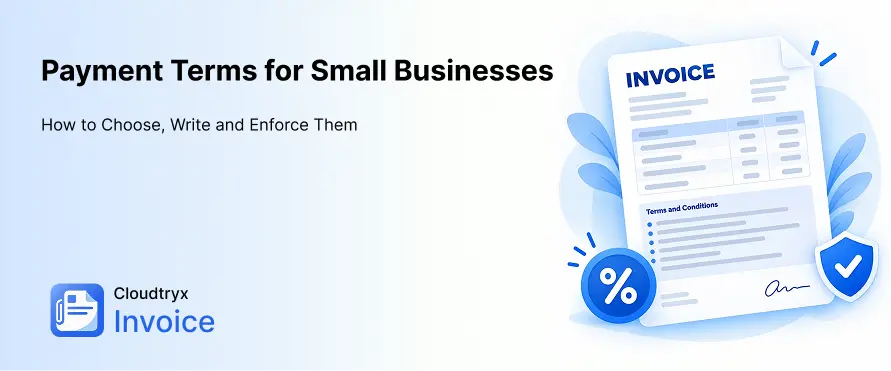
Payment Terms for Small Businesses: How to Choose, Write and Enforce Them
Even if for once in your life, you must have chased payments after delivering great work. What if we tell you, the problem probably wasn’t your client. It was your payment terms.
Payment terms set by the service provider, i.e you, are the rules that tell a customer when and how to pay you. When they’re clear, cash arrives on time. If you set vague due dates, or don’t convey them at all, clients end up forgetting to pay. You may also find yourself sending awkward “gentle reminder” messages while your own bills pile up.
In this guide we cover what payment terms for a small business are. We will also talk about how to choose payment terms, how to write them on an invoice, and how to enforce them without damaging client relationships. It’s written with Indian founders, freelancers and small-business owners in mind, so it includes the legal context that matters here.
What are Payment Terms?
Payment terms refers to the conditions you set for your customer, stating when they should pay, how much, and by which method. They are mentioned on the invoice itself, or other similar documents if you create them, like quotation or contract. They cover the following:
- Due date: the date or the number of days within which payment is expected
- Payment method: UPI, NEFT/RTGS, IMPS, cheque, card or payment link
- Advance or deposit: any amount payable before work begins
- Late payment consequences: interest or fees if the deadline is missed
- Early payment incentives: an optional discount for paying sooner
Payment terms can be considered the same as the “rules of the game” that you and your client agree on before any transaction begins or money changes hands.
Payment Terms Matter More for Small Businesses
Large companies can absorb a delayed payment. A small business usually can’t. They already have a lot to take care of, and delayed payments from clients result in falling back on other payments like salaries, rent, GST payments and vendor bills.
Since late payments are a major problem for Indian small businesses, the Government of India has acted on it. The MSMED Act, 2006 requires buyers to pay micro and small enterprises within 45 days of acceptance of goods or services, or within 15 days if there is no written agreement. Meaning, if no due date is mentioned on the documents, the payment needs to be cleared within 15 days. Since FY 2023-24, Section 43B(h) of the Income Tax Act also stops buyers from claiming a tax deduction on payments to micro and small suppliers that are delayed beyond these limits.
Clear written terms work in your favour in three ways:
- Predictable cash flow: you know when money will arrive from the client, and can plan things for your business, accordingly.
- Fewer disputes: clients can not claim that they were not aware of the due date to clear payments.
- A stronger legal position: if a payment dispute escalates, documented terms are your best evidence.
Common Payment Terms Explained
Let us now understand some common terms related to payments, that every small business should know for smoother operations.
Due on Receipt
You receive payment from the client as soon as they receive the invoice. Best for small-ticket works, one-off projects or new clients with whom you haven’t dealt before.
Net 7, Net 15 and Net 30
“Net” followed by a number means the full amount is due within that many days from the invoice date. Such terms are often used while creating invoices.
Net 30 payment terms
These are the global default. An invoice dated 1 March with Net 30 terms is due by 31 March. Net 30 is a commonly used payment term since it operates on a monthly cycle, and many corporate clients expect payments within a month of delivering services. Additionally, it gives a sense of cash flow comfort to small businesses. For solopreneurs, Net 5 or Net 7 is the ideal payment term and more realistic too.
Net 45 and Net 60
Longer terms are common with large enterprises and government bodies. You should only accept these terms when the wait time justifies the cost of the project. Also, remember that under the MSMED Act, micro and small suppliers have a legal ceiling of 45 days.
Advance Payment or Milestone Payments
A part of the payment is received upfront, before the service starts, and the rest is received as per the agreed terms. A typical split is 50% to start and 50% on delivery, or 40-30-30 across three milestones. This works well for projects, design, development and consulting, because it protects you from non-payment on long engagements.
EOM (End of Month)
Payment is due at the end of the month in which the invoice is issued. “Net 30 EOM” means 30 days from the end of that month. A caution is that this extends the wait time to a total of 60 days, in some cases, when the service is delivered early in the month.
Early Payment Discount (e.g., 2/10 Net 30)
This means the client gets a 2% discount if they pay within 10 days, otherwise the full amount is due in 30 days. Such schemes help speed up the payment, but discounts can be applicable if your margins allow such payment cuts.
Retainer or Recurring Billing
You invoice a fixed amount on a set date each month. It suits ongoing services such as marketing, bookkeeping or support, and it creates predictable revenue.
How to Choose the Right Payment Terms
There’s no one size fits all. You can pick terms based on the below factors:
1. Your cash flow. Determine the number of days you can comfortably wait for the payment. If your own expenses are due in 15 days, offering Net 45 is a risk to your business.
2. Client type and size. When working with individual buyers or new clients, a shorter net is recommended, since this way you can assure that the payment will be received. An advance from such clients works best too. When dealing with larger corporations or enterprises, you can offer more wait time, like Net 45 or 60.
3. Project size and duration. For big or long projects, use milestones instead of one large invoice at the end.
4. Industry norms. Check what’s standard in your sector. Different cycles work best for consultants, agencies and manufacturers.
5. Risk. If there’s any doubt about a client’s reliability, ask for an advance or even full payment in some cases before delivery.
Many freelancers usually follow a simple rule, where they seek advance payments from new clients, whereas offer Net 15 or 30 from trusted and retainer clients.
How to Write Payment Terms on an Invoice
Professional invoices have good payment terms mentioned specifically for anyone to understand. They are also impossible to be missed or misread. Here’s what to include.
Must-have elements:
- Invoice number and invoice date
- A clear due date (write the actual date, not just “Net 30”)
- Total amount payable, including GST where applicable
- Accepted payment methods and your bank or UPI details
- Late payment terms
- Your GSTIN, if you’re registered, since a GST invoice must carry the details required under GST rules
Sample payment terms you can include in your invoice:
- Payment is due within 15 days of the invoice date. Payments can be made via UPI, NEFT or bank transfer to the account details below. Invoices unpaid after the due date will attract interest at 1.5% per month on the outstanding amount.
- 50% advance is payable before work begins. The balance is due within 7 days of final delivery.
Tips for clearer wording:
- Include a calendar date at the due date field to avoid any confusions on client’s end.
- Late fees and interest should be realistic and reasonable. If providing the quotation or contract, the same should be mentioned there too.
- Use a consistent format across every invoice so clients get used to it.
Drafting an invoice manually in a Word or Excel file every time is slow and error-prone. With Cloudtryx Invoice’s free invoice generator, you can create a professional invoice in seconds. The invoice generator allows you to add your payment terms, due date, bank or UPI details and GST information in minutes. If you register for an account, the same terms and client details can be reused every time you invoice the same client.
Payment Terms in India: What You Should Know
If you invoice Indian clients, a few local points deserve attention:
- MSMED Act protection: if you’re registered as a micro or small enterprise (Udyam registration), you automatically come under the 45-day rule. Interest on delayed payments can be charged at three times the bank rate notified by the RBI, compounded monthly. Getting Udyam registered is worth it for this payment term alone.
- GST invoicing: When invoicing as a tax registered business, your tax invoice must include the mandatory details such as GSTIN, HSN/SAC code, tax breakup and invoice number if you’re GST-registered. All these information should be paired along with the payment terms on a clean, professional, compliant document.
- TDS: many business clients will deduct TDS before paying. Mention in your terms that the gross invoice amount is payable and that TDS certificates must be shared.
- UPI and bank transfers: these are the fastest and most trusted methods. Including a UPI ID or QR code on the invoice noticeably reduces payment friction.
- Written agreements matter: without a written agreement, the legal timeline can drop to 15 days under the MSMED Act, but it’s far easier to enforce when you can show what the client accepted. Get terms confirmed by email at the very least.
Note: this is general information, not legal or tax advice. For disputes or large amounts, consult a CA or lawyer.
How to Enforce Payment Terms (Without Losing the Client)
The Terms only work if you follow through. Listed below is the sequence that you should follow.
Before the due date
- Send a friendly reminder 2 to 3 days before the due date, if the invoice stands unpaid still.
- Send the invoice the same day the work is delivered. Every delayed day in sending through the invoice will result in delayed receipt of payments.
On the due date
- Send a short note with the invoice attached and payment details repeated.
After the due date
Once the due date crosses, sending payment reminders in a consistent format and politely is suggested, so that you receive payments at the earliest possible. Also, your clients stay away from paying interest on delayed payments.
- Day 3 to 7: polite follow-up by email and a quick call or WhatsApp message.
- Day 15: a firmer email that references the agreed terms and applicable late fee.
- Day 30: a formal reminder, ideally pausing further work until the dues are cleared.
- Day 45 onwards: a legal notice from a lawyer, and for micro and small enterprises, a complaint on the MSME Samadhaan portal or to the Micro and Small Enterprises Facilitation Council.
Sample follow-up message that can be used as a template:
Hi [Name], a quick reminder that Invoice #[number] for ₹[amount] was due on [date]. Could you confirm when we can expect the payment? Happy to resend the payment details if helpful.
Habits that make enforcement easier:
- Keep all communication in writing.
- Maintain politeness, but be consistent. Clients take you more seriously when you follow your own rules.
- Stop work for the following month if the invoices stay overdue.
- Track which invoices are paid, pending or overdue in one place, or through an organised invoicing software, so nothing slips through.
Frequently Asked Questions
Payment terms refers to the conditions laid by the supplier to the buyer stating how should the payment be made, the due date, accepted payment methods, and late fees on overdue invoices.
Net 30 means the full invoice amount is due within 30 days of the invoice date. For example, if you issue an invoice on the 1st of May, the due date of the invoice will be May 31.
For most small businesses, Net 15 or Net 30 is best suited for retainer and trusted clients. Whereas for dicey clients or the new ones, taking part payment in advance and the balance in Net 5 or 7 is recommended.
For micro and small enterprises, the MSMED Act sets 45 days from acceptance of goods or services with a written agreement, and 15 days without one.
Yes, but you need to state the same in your quotation or contract, and the client should agree to the same. Micro and small enterprises can also claim statutory interest under the MSMED Act.
With the help of an invoicing software, you can quickly add payment terms to the invoice. Even the free invoice generator of Cloudtryx Invoice lets you add payment terms, a due date and payment details to a ready-to-send invoice.
Final Thoughts
Good payment terms doesn’t mean being strict with your clients, but it’s about being clear. You need to decide what works for your cash flow, put it in writing, state it on every invoice, and follow up consistently.
Ready to put clear payment terms into practice? Create a professional invoice with your payment terms, due date and GST details using the invoice generator from Cloudtryx Invoice. A free account is best suited if you invoice regularly, and it also lets you reuse your terms and keep track of what’s paid and pending.