GST Invoice Format in India: Mandatory Fields + Free Template (2026)
A valid GST tax invoice needs 16 mandatory fields under Rule 46 of the CGST Rules. However, there is no official visual template, you just need to get the…
A valid GST tax invoice needs 16 mandatory fields under Rule 46 of the CGST Rules. However, there is no official visual template, you just need to get the required fields right in your tax invoice. The mandatory fields include GSTIN, invoice number, HSN/SAC codes, taxable value, and the tax split (CGST/SGST or IGST). You will find free, ready-to-use templates for B2B, export, and composition invoices available with a free Cloudtryx Invoice account. Take note that if your turnover exceeds ₹5 crore, e-invoicing through the government portal is mandatory from April 1, 2026, and then even a correct invoice with all mandatory fields is not enough.
What Is a Tax Invoice Format?
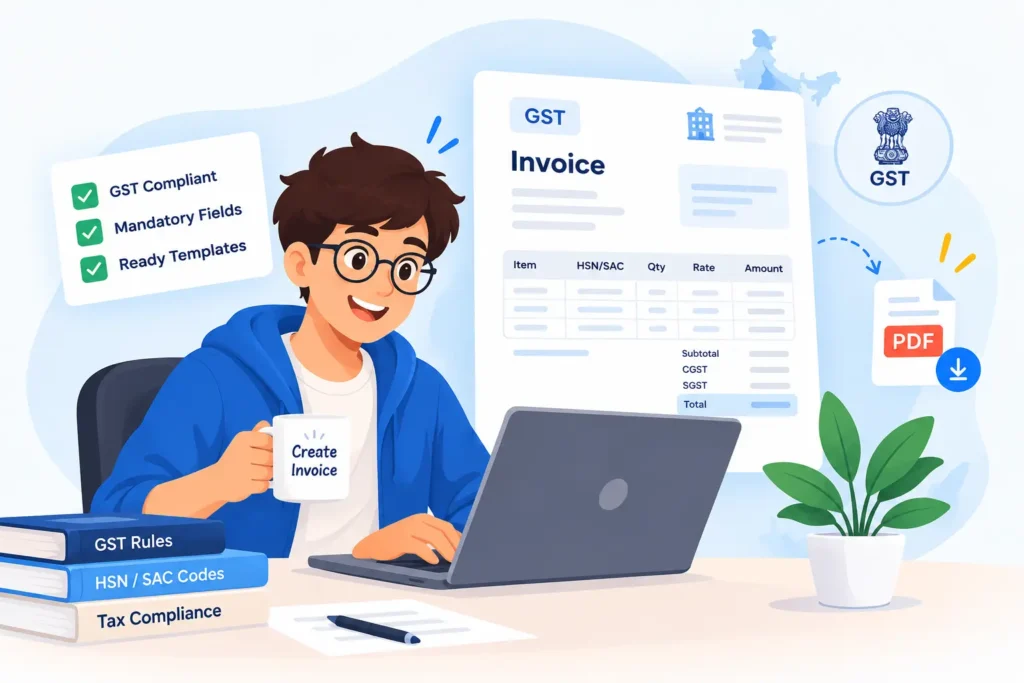
A tax invoice bill format is often misunderstood as a fixed format issued by the government. It isn’t. GST law specifies that a tax invoice must include required information, clearly spotted in the document, and has nothing to do with the look.
Under Rule 46 of the CGST Rules, 2017, the government has not laid out a specific visual design. Your business can use any layout, font, or branding it wants, in Word, Excel, or even a dedicated GST invoicing software to create tax invoice bills. The only requirement from the government is that all mandatory fields should be present and accurate. Get even one field wrong, and even a professionally designed invoice becomes non-compliant.
The 16 Mandatory GST Fields In A Tax Invoice (Rule 46)
Every tax invoice issued by a GST-registered business must contain 16 fields. Know them below so that the next time, your invoice doesn’t stand cancel at your customer’s end, without you knowing about it:

“Tax Invoice” – the document should include this exact term at the head, to make it GST-compliant in India.
Supplier’s name, address and GSTIN – GSTIN is the Goods and Services Tax Identification Number assigned to businesses registered under tax.
Unique invoice number – every tax invoice should contain a unique, sequential number of up to 16 characters, that resets each financial year
Invoice date
Buyer’s name, address, and GSTIN (if registered)
Buyer’s name, delivery address, and state code – stands mandatory if the buyer is unregistered and invoice value is ₹50,000 or more
HSN or SAC code for each item or service
Description of goods or services being traded
Quantity and unit for goods
Taxable value after all applicable discounts
GST rate applicable
Tax amount – if the trade is intra-state split into CGST + SGST or IGST amount if inter-state
Place of supply, with state name and code for inter-state transactions
Whether tax is payable under reverse charge
Signature or digital signature of the supplier or authorised signatory
Delivery address, if different from the place of supply
Out of the sixteen fields, two fields apply only in specific cases: buyer details are mandatory for B2C sales of ₹50,000+, and the reverse-charge declaration only applies where reverse charge is triggered.
If you are missing any of the above stated fields, your invoice stands invalid. If the buyer is also registered under tax, their input tax credit gets blocked, and a penalty of up to ₹25,000 per invoice gets attracted under Section 122 of the CGST Act.
Tax Invoice Templates
A single generic template doesn’t fit every transaction. Indian businesses run into six distinct invoicing scenarios, and each trade or business type needs slightly different fields. Below we list different templates that distinct business types will need, and the document can be in Word, Excel or PDF:
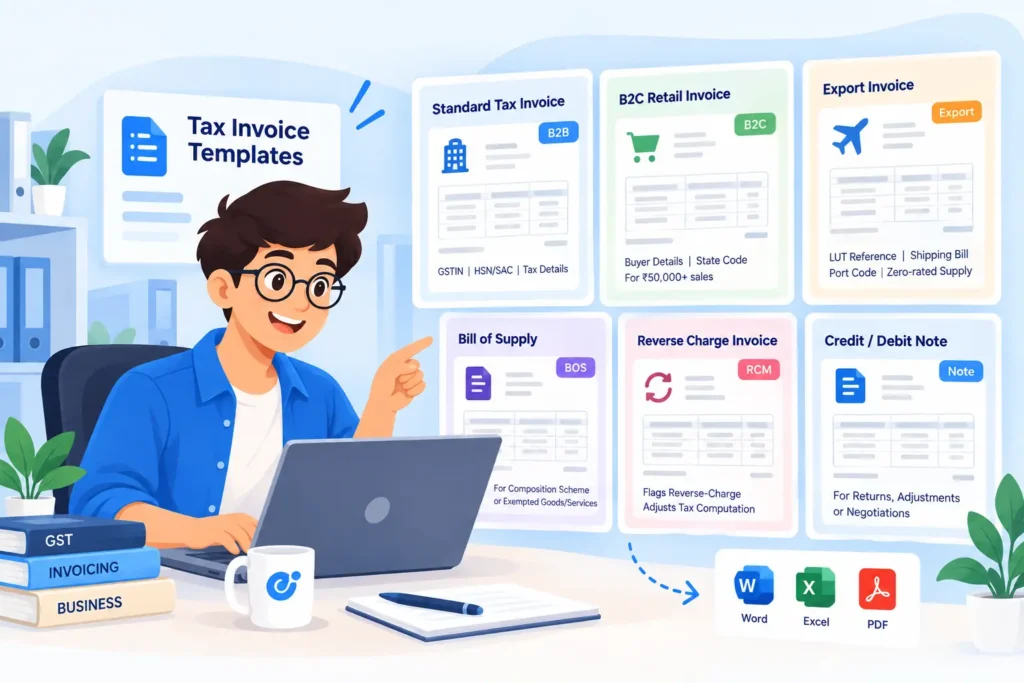
This tax invoice format is a default type for registered-to-registered sales, with full GSTIN and HSN details. Meaning, both the seller and the buyer are registered under tax.
It includes fields like buyer name, address, and state-code, as the buyer is not registered and the sales is of higher value.
Built for zero-rated supply, with LUT reference, shipping bill number, and also port code fields.
Applicable format for composition-scheme dealers and exempted goods/services, when no GST is charged.
This format flags reverse-charge applicability and adjusts the tax computation accordingly.
It is issued to correct figures or adjust amounts post sales, due to returns, negotiations, etc.
If you are using our GST billing software in India, in each template the CGST/SGST vs. IGST gets automatically calculated based on the buyer’s state. You will not have to work on amount splits and totals manually. The invoices generated are all tax-complaint and widely accepted for easy return filings.
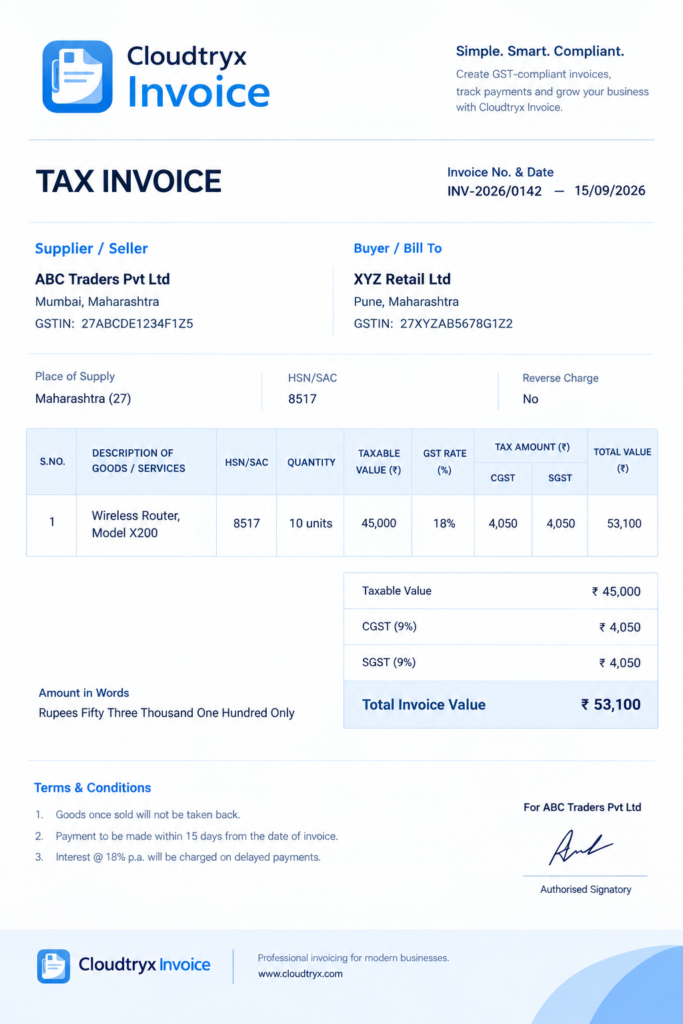
Sample Filled-Out Tax Compliant Invoice
Have a look at the below image to get an understanding of how a compliant Standard Tax Invoice (B2B) should be, in practice, with each mandatory field labeled:
Other Invoice Format Rules Besides The Mandatory Fields
There are a few other GST invoicing rules that go beyond the mandatory fields content and affect how and when you issue the document:
Copies required: Every business requires 3 copies for a supply of goods original for buyer, duplicate for transporter, triplicate for supplier; and 2 copies in case of services original for buyer, duplicate for supplier.
Time limit: Invoice for goods should be issued before or at the time of removal for supply. For services, it can be issued within 30 days of the date of supply.
Digital signatures are legally valid on a GST invoice under the IT Act, 2000. If the invoice is printed or is a digital version, a printed name of the authorised signatory is acceptable.
No letterhead is legally required. Many businesses assume branded letterhead is mandatory, but it isn’t. What matters is that the invoice should include all 16 fields and the business branding is optional.
E-Invoicing: When “Format” or Fields Aren’t Enough
Getting the format and fields right stops being sufficient once your business crosses a certain limit in terms of turnover.
E-invoicing became mandatory for businesses with aggregate annual turnover (AATO) above ₹5 crore from April 1, 2026, under Notification No. 17/2025-CT. Turnover of a business is calculated on the basis of its PAN all over. That said, if your business has multiple branches or contains state-wise GSTINs, the turnover taken into consideration will be a total of all outlets.
Once you cross this threshold, a well-formatted invoice with all mandatory fields is no longer valid on its own. It must be reported to the Invoice Registration Portal (IRP), which returns a unique Invoice Reference Number (IRN) and a digitally signed QR code. Both must appear on the invoice before it’s sent to the buyer.
We will be soon releasing a complete guide on the e-invoicing rules, thresholds and also the reporting process to make it easy for you to understand and take action.
Common Mistakes That Invalidate a Tax Invoice
Even businesses using a compliant template often make these errors:
Copying the customer’s billing address as the place of supply – Know that the two aren’t always the same, and getting this wrong will change the type of tax applicable, whether it is CGST+SGST or IGST.
Skipping HSN codes on low-value items – Do not assume that the HSN code is optional for items under a certain amount. For any B2B taxable supply, the information is mandatory.
Non-sequential or reused invoice numbers – Numbers of tax invoice must be consecutive and unique for the financial year. Skipping or repeating numbers is a common red flag that creates problems at the time of audits.
Missing the reverse-charge declaration – The declaration on transactions where it applies, shouldn’t be missed even when the tax amount is calculated correctly elsewhere on the invoice.
Any one of these mistakes or errors will block the ITC claim for your buyer. To avoid such troubles, ensure that every invoice generated and handed over to your buyer is fully compliant. To avoid such risks, using a reliable and affordable cloud based invoicing software is the best approach.
It helps skip the manual template altogether. Cloudtryx Invoice auto-generates every field under Rule 46, applies the correct CGST/SGST/IGST split automatically, and will soon be handling e-invoicing and IRN generation if you cross the ₹5 crore threshold, so nothing on this list gets missed.