How to Make Your CA’s Job Easier: Invoice Habits That Simplify Bookkeeping and GST Filing
Have you ever asked your CA what slows down GST returns for them? You will rarely find them saying that it is complicated tax laws. They will say, it is the paperwork that they need to do at the time of filing. They usually receive invoices with missing GSTINs, numbers that skip or repeat, a few that were edited after the fact, and a bank statement full of credits nobody can match to a customer.
While filing your CA has to sort all of it out. But sorting takes hours, and they charge extra for the same. If they are late in filing returns, it will also mean late fees, interest and delayed tax credit, all coming out of your pocket. Clean invoices work the other way. They cut the back-and-forth, ensure filings on time, and leave your CA worry-free about the last moment paperwork. Also, they get to do what they are getting paid for, which is advice on tax, cash flow and growth, not data repair.
This guide walks through the invoicing habits that make the biggest difference, covering what your CA needs and what it means for your cash flow, compliance and customers. It also contains a monthly handover checklist you can copy.
What Your CA Does With Your Invoices?
It helps to know where the invoices go. Roughly:
- Sales invoices feed your GST return (GSTR-1), your output tax and your sales ledger.
- Purchase bills support the input tax credit you claim, and the expenses in your books.
- Payments and bank entries are matched against both, so receivables and payables stay accurate.
- Everything together becomes your profit and loss, your balance sheet, and the records an officer would ask for in a notice or audit.
Business owners often miss one important detail: your customers’ input tax credit depends on what you report. If your invoice has the wrong GSTIN or isn’t properly reported, their credit doesn’t show up correctly, and they’ll come back to you. Having said that, a sloppy invoice becomes a problem for two businesses instead of one.
What It Means For You As The Owner?
Better invoicing practices is not only a favor to your CA. It also protects your money.
- Lower CA fees – Less messy invoices mean less cleanup, and you only pay for the actual work.
- Fewer penalties – On-time, accurate returns will help avoid late fees and no interest.
- Smoother tax credit – Correct information on the invoices and reports help you and your customers claim input credit without delays.
- Better cash flow – Clear, correct invoices get paid faster, and recorded payments show who still owes you.
- Stronger books – Lenders, investors and buyers ask for tidy records when you need them most.
While Issuing Get Your Invoices Right
Fixing an invoice later costs far more than getting it right the first time. CAs often end up correcting some of the common mistakes on invoices.
Customer name and GSTIN – When selling to registered businesses, their legal name and GSTIN should match what’s on the GST portal. Even a small typo will not help reconcile the invoice and your customer won’t be able to claim tax credit smoothly or on time. Ask for the GST certificate or check the number once, then save it in your customer record.
Place of supply – It helps decide whether you are charging IGST(between states) or CGST and SGST(within states) . It’s the single most common reason an otherwise correct invoice needs redoing. If you serve clients across states or abroad, ask your CA how each type of sale should be treated.
HSN or SAC code – Each product needs an HSN code, and service a SAC code. The number of digits you must show depends on your turnover, and the rules have been updated before. Hence you should collect requirements from your CA, and add codes in your system.
Tax rate and tax amount, shown separately – Don’t show a lump sum with GST “included” and nothing else. List the information properly, taxable value, the rate, and the tax amount for each component. Applying the wrong rate to a product or service is another frequent correction, so keep a reference list of your items with their right rates.
Invoice date and the time limit – For services, GST rules generally expect the invoice to be issued within 30 days of the supply. For goods, it should be issued at or before delivery. Invoices raised weeks after the work are hard to match to the right tax period, and they delay payment too.
The right document for the situation – A registered business charging GST issues a tax invoice. A bill of supply is issued by a composition taxpayer, or a business selling exempt goods or services. Exports and supplies under special arrangements have their own conditions. If you are unsure which applies, ask before you send, not after.
Reverse charge and special cases. If tax is payable by the customer under reverse charge, the invoice should say so. Same for anything unusual: advance payments, discounts given after the sale, or sales to special economic zones. Tell your CA about them when they happen, not at the time of filing.
One more check, which is not for everyone though: if your turnover crosses the threshold for e-invoicing, your invoices must be reported to the government’s invoice registration portal. Your CA will tell you whether this covers you, and your invoicing software needs to support it if so.
Number Your Invoices Like Someone Will Audit Them
GST rules require unique, sequential invoice numbers on each of them. The number can be of up to 16 characters long, using letters, numbers, hyphens or slashes. In practice, this works well:
- Choose one format and keep it. For example, INV/26-27/0041, which contains the document type, the financial year and a running number.
- At the start of each financial year, start the count again, and make the year part of the number so nothing repeats.
- Never reuse a number, that should include cancelled invoices.
- Don’t leave unexplained gaps. If a number is cancelled or issued in error, keep a note of why, because gaps are one of the first things an auditor or officer asks about.
- If you need separate series, for different branches or different document types such as credit notes, set them up deliberately and label them.
One of the most common problems CAs face is while dealing with businesses which create invoices in Word, Excel and a billing app at different times, with different numbers in each. Pick one place to issue invoices, and use that alone.
Use Credit Notes and Debit Notes Instead of Editing Invoices
Let us see a scenario CAs see all the time.
You send an invoice for ₹1,18,000. The client points out that a ₹10,000 item was supposed to be removed. You open the file, change the amount, and send it again with the same number.
The problem is that the original may already have been reported in your return and recorded in your customer’s books. The corrected copy now doesn’t match with both the records, and nobody can see what changed or why.
The best way to tackle such a situation is to leave the original invoice untouched and issue a credit note that refers to it, showing the reduced amount and adjusted tax. If the amount needed to go up, a debit note does the same job in the other direction. Your CA can then adjust your tax liability properly, and the trail makes sense to anyone reading it later.
You should remember two points: Credit notes carry their own tax rules, including a deadline linked to the end of the financial year for adjusting the tax, so raise them promptly rather than months later. And don’t delete invoices from your system. Cancel them with a recorded reason.
Match Every Payment To Respective Invoices
An invoice isn’t finished the moment it’s sent. It is finished after being paid, and the receipt is recorded against the raised invoice. When that step is skipped, your CA gets a bank statement with credits like “NEFT from ABC Pvt Ltd, ₹89,100” and has to guess which invoice it covers, and you will also not get the details of who owes you money.
Make sure you note, for each payment, the date received, the amount, the mode, and the invoice number or numbers it settles. Be extra careful for the following cases:
TDS deductions – Many business customers deduct tax at source before paying you, so what reaches your account is lower than the invoice total. A ₹1,00,000 invoice might arrive as ₹90,000. That difference isn’t a short payment. It’s tax your customer has deposited on your behalf, and you’ll need the TDS certificate (Form 16A) to claim the credit when you file your income tax return. Record the deduction separately, and ask for the certificate each quarter. You can cross-check it against Form 26AS or your AIS.
Part payments – If a customer pays in installments, you need to record each one received against the same invoice so the outstanding balance stays accurate.
Advances – Money received before the work is done has a separate tax treatment, and the rules differ between goods and services. Tell your CA about every advance when it arrives, and make sure it’s adjusted against the final invoice.
Bank charges and forex differences – For international clients, the amount credited often differs slightly from the invoice because of charges and exchange rates. Keep the remittance advice so your CA can explain the gap.
Keep Your Purchase Bills In Order Too
Everything so far concerns invoices you issue. But your CA will also need the purchase bills, because they include your input tax credit claims and your expenses. While maintaining purchase bills, keep a few habits in check:
- Collect bills with the supplier’s GSTIN on them – Without this information, credit is difficult or impossible to claim.
- Ask suppliers to confirm they file their returns – Input credit generally depends on when the invoice is reported by the supplier, and it appears on the automatically generated GSTR-2B. If they haven’t, your credit can be delayed.
- Hand over bills in the month they belong to – Credits need to be claimed in the same period and not long after, claiming them during the wrong period creates a mismatch and issues that get difficult to untangle.
- Separate personal from business expenses – By mixing them, your CA ends up sorting them out, and some categories of purchase don’t qualify for input credit at all, so ask which ones.
Store Records In One Place And Have One Naming Habit
Invoices scattered across email, WhatsApp, a desktop folder and a drawer mean your CA, or you, will spend time hunting. Make it a habit of maintaining one system. The best is using an online billing software that will take care of all your invoices. Alternatively, you can also maintain invoices on a shared drive, or both, as long as it’s the same one each month.
A consistent file name helps more than people expect. Something like 2026-10-15_INV-26-27-0041_ClientName.pdf is a great invoice naming practice. The name is sorted by date, shows the number at a glance, and is easy to search. GST law requires you to keep records for eight long years, so choose a system that can store the information for those long years and stays readable well down the line.
A Monthly Handover Checklist
If your business files monthly, GSTR-1 is generally due on the 11th and GSTR-3B around the 20th of the following month. QRMP filers have different dates, so confirm yours. Irrespective of which date you are filing on, if you give your records by the 5th to your CA, they have time to review, ask questions and file without a rush.
Keep the below checklist handy with you so that you can follow every month:
- All sales invoices for the month, in number order, with any cancelled numbers explained
- Credit notes and debit notes, each linked to its original invoice
- Purchase bills and expense invoices, with supplier GSTINs
- The bank statement for the month
- A list of payments received, matched to invoice numbers
- TDS deducted by customers, with certificates received so far
- Advances received or paid
- Anything unusual: disputed invoices, export sales, sales to SEZ units, or changes in rates or customers
- Any notice or message received from the GST department
Once a year, you should check for a few other documents too: a list of unpaid invoices at year end, a reconciliation of your GST returns with your books, and your invoice series with any gaps noted.
Mistakes CAs See Again and Again
If you only fix a few things, fix these:
- Wrong or missing customer GSTIN
- Wrong place of supply, so the wrong tax type is charged
- Invoices edited or deleted after being sent
- Duplicate numbers, or two series running in parallel without a plan
- Payments recorded without invoice references
- TDS deductions treated as unpaid balances
- Invoices sent by chat apps and never filed
- Personal expenses mixed into business bills
None of these is difficult to prevent. Such mistakes occur again and again because you don’t follow a routine while creating GSt invoice. Follow the steps of creating valid GST invoices and you will not have incorrect information on them.
Where Invoicing Software Helps
Manual invoicing needs someone who can remember all the invoicing rules everytime. With a reliable invoicing software you enter the rules once. Your GSTIN, your items with HSN or SAC codes and tax rates, your customers’ details and your numbering series live in the system, so every invoice follows the same pattern. Every other report, payment tracking and credit notes then follow from the same data, and you get one place to see who has paid and who hasn’t.
That’s the idea behind Cloudtryx Invoice: create GST-ready invoices in a consistent format, track what’s been paid, and hand your CA clean data each month. Our simple and easy to use online billing software for small businesses in India will handle all your invoices with ease. If you are using some other tool for your business invoicing, check that it handles the points above: unique numbering, tax shown by component, credit notes, and records you can export.
Frequently Asked Questions
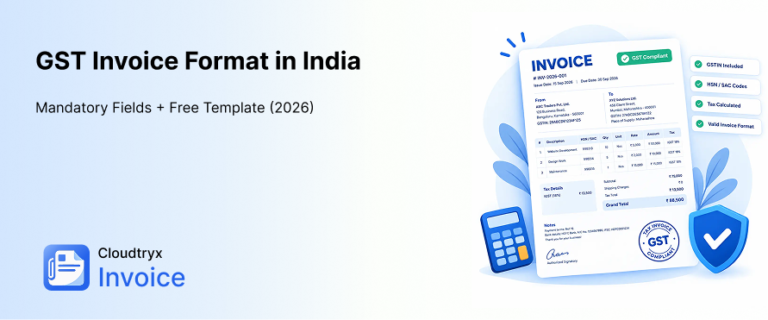
At minimum: your name, address and GSTIN, a unique invoice number and date, the customer’s details (with GSTIN for registered buyers), a description of the goods or services with HSN or SAC code, quantity and taxable value, the tax rate and amount by component, the place of supply and the total. Your CA can confirm what else applies to your case.
Use a unique, consecutive series of up to 16 characters that doesn’t repeat within a financial year. Many businesses include the document type and financial year in the number.
If the invoice is already being sent, and then you spot the mistake, do not edit the invoice. Issue a credit note or debit note that refers to it, then a new invoice if needed.
Ideally by the 5th of each month. Monthly returns are generally due around the 11th and the 20th, so sending early gives them time to review the information and ask questions.
Start from the moment you know you have been making mistakes in invoicing. Fix your numbering and invoice details going forward, send your CA a list of known gaps, and ask them to clean up earlier months in one go.
The short version
Tidy invoices are good practice that pays for itself. Get the details right when you issue them, number them consistently, correct mistakes with credit notes, match every payment, and hand your records over on a schedule.
Your CA gets time back, you pay less in fees and penalties, your returns go in without a scramble, and your own books show you where your money is.
This article gives general information about GST practice and is not tax advice. Rules, thresholds and deadlines change, so check specifics with your CA.